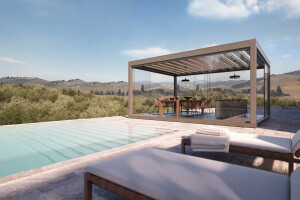
This single-family dwelling is located in a newly developing urban expansion area on the outskirts of Jaén, a context devoid of significant landscape or architectural references. Confronted with this condition of urban anonymity, the project adopts an introspective logic, resulting in a domestic space that turns inward—closing itself off from its immediate surroundings and instead oriented towards an internal void conceived as a domestic oasis. This central courtyard emerges not only as an organizing element but as the true heart of the project: a space for retreat, enjoyment, and climatic regulation.


The house is structured across a ground and first floor, articulated in an L-shaped configuration that clearly defines the functional zoning. One wing of the volume houses the guest area, while the other concentrates the primary day-to-day living spaces. At the junction of these two wings is located the main living room—a double-height space that acts as a spatial and visual hinge. This effect is reinforced formally by an inclined roof, which mediates between the single- and double-storey volumes, enriching both the interior spatial perception and the relationship with the courtyard.


The dwelling focuses its gaze and daily life inward, toward the central courtyard, a space defined by the presence of a swimming pool as its central and symbolic element. The pool becomes a visual anchor for the main interior spaces, orchestrating a continuous sequence of indoor and outdoor experiences. The built mass steps back to generate generous overhangs—tectonic ovoids—that function as transitional voids capable of passively regulating the thermal conditions of the inhabited spaces: they shield the interior from high summer sun while allowing solar heat gain during the lower-angled winter months.


Only the gym breaks with this introspective logic by opening outward. However, it does so through a filtering architectural lattice that ensures privacy while reinforcing the abstract and restrained character of the house’s formal language—clearly contrasting with the heterogeneous and nondescript aesthetic of the surrounding urban environment.